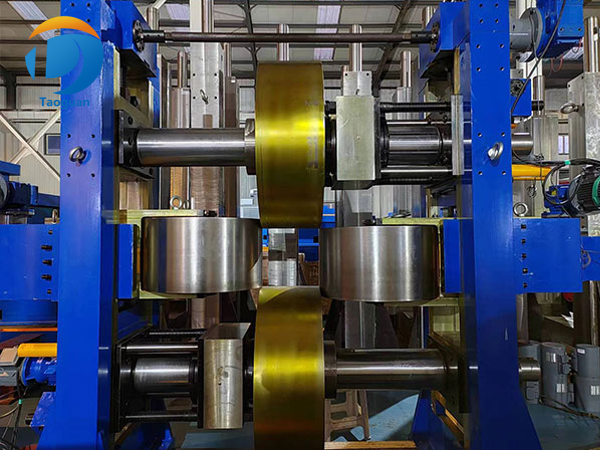
Welding Methods in Stainless Steel Pipe Production Lines
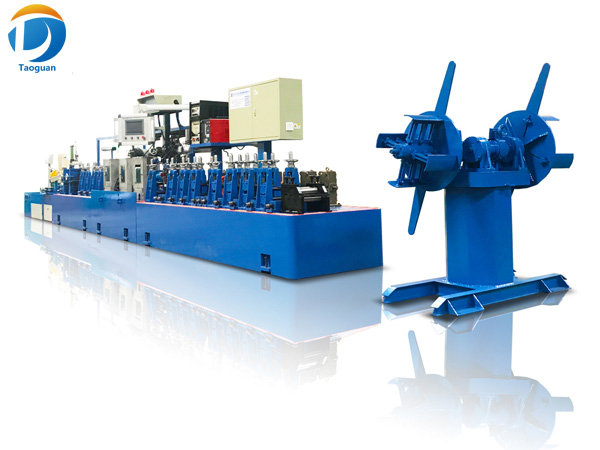
Stainless steel pipe welding demands deep penetration, oxide-free joints, and minimal heat-affected zones. Below are the core techniques used with modern Stainless Pipe Making Machines:
1. Tungsten Inert Gas (TIG) Welding

Application: Ideal for chemical, nuclear, and food-grade pipes.
Advantages:
Exceptional weld quality and full penetration.
Uses argon shielding to prevent oxidation.
Innovations:
Multi-Torch Systems: 3-torch TIG Stainless Welding Machines (e.g., German technology) boost speeds by 3–4x for pipes with wall thickness ≥2mm.
Hybrid Solutions: Combining TIG with plasma welding or adding 5–10% hydrogen to argon further enhances efficiency.
Material Compatibility: Austenitic and ferritic stainless steels.
2. High-Frequency (HF) Welding

Role in Production: A cost-effective method for structural, decorative, and appliance pipes.
Advantages:
10x faster than TIG welding.
Adapts to various diameters/wall thicknesses with low power consumption.
Limitations:
Internal burr removal challenges.
Not yet accepted in chemical/nuclear industries.
Progress: Modern HF Stainless Pipe Making Machines now weld austenitic steels and ferritic grades (e.g., AISI 409).
3. Combined Welding Technologies
Trend: Hybrid methods maximize speed/quality while minimizing costs.
Popular Combinations:
TIG + Plasma Welding
HF + Plasma Welding
HF Preheating + Multi-Torch TIG
Benefits:
Near-instant weld speeds.
Seam quality matches standalone TIG/plasma.
Easily automatable and compatible with existing HF equipment.
Industry Adoption: Widely used in Japan and France.