Steel Pipe Making Machine Faults: Analysis of the causes of vertical roller deviation
1. The heights of the two vertical rollers are different
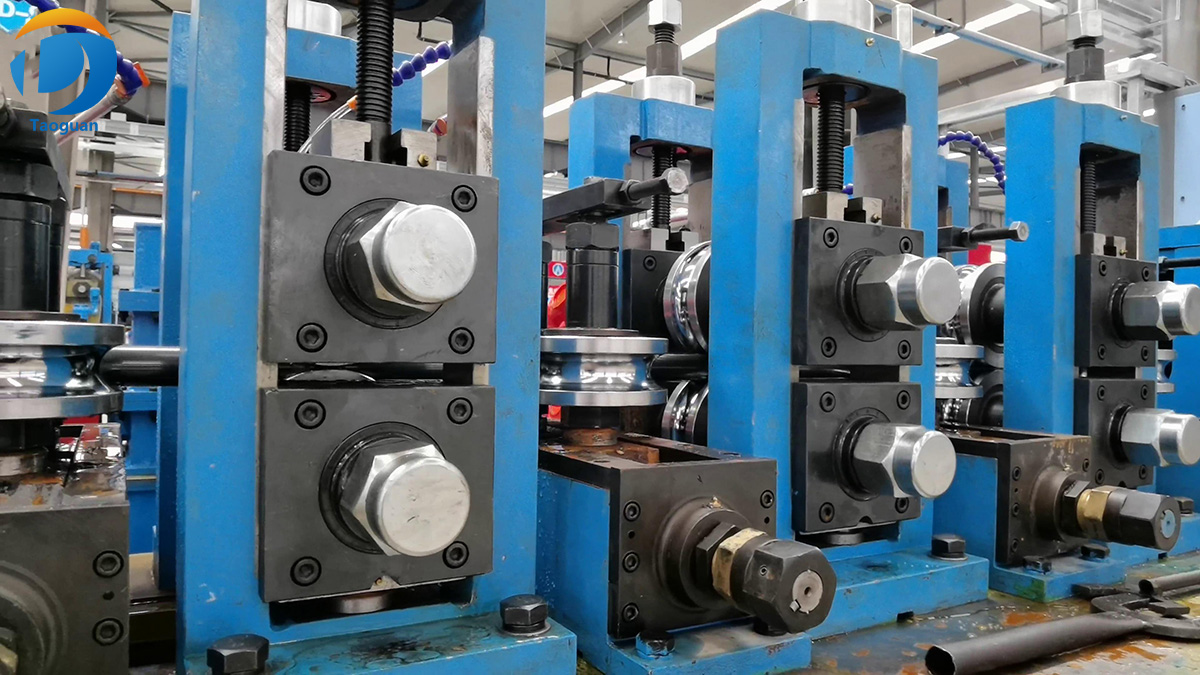
When the heights of the two vertical rollers are different, it is easy to cause the tube billet to flip in the hole. The greater the height difference, the more serious the tube billet flipping. Generally, the tube billet will flip to the side with the higher vertical roller (Figure 12). Slight height difference can be verified by using a steel ruler to detect the upper boss of the vertical roller. In severe cases, it can be detected directly by touching with fingers.

2. Bearing damage
When the vertical roller bearing is damaged, it is easy to cause the tube to deviate. After the bearing is damaged, the vertical roller hole cannot control the stable operation of the tube well, and the height position of the two vertical rollers is also destroyed. When the upper end bearing of the vertical roller is damaged, the tube will turn over to the side of the hole where the bearing is damaged; when the lower end bearing of the vertical roller is damaged, the tube will turn over to the side of the hole where the bearing is intact. At the same time, the severity of the bearing damage must also be considered.
3. The front flat roller is incorrect
At the flat roll before the vertical roll, the tube has already deviated, which is mainly due to the misalignment of the flat roll center. When the center deviation is small, the tube can barely enter the vertical roll hole. Once the vertical roll is slightly inappropriate in some aspects and the flat roll center deviation is large, the tube will deviate and flip, so the flat roll hole must be adjusted to the center position. If the flat roll center is only slightly misaligned, good results can be achieved by adjusting the flat roll pressure.
4. Different sizes of vertical rollers
When replacing the vertical rollers, it is important to note that the outer diameters of the two vertical rollers should be the same. If the difference is too large, the contact effect between the hole arc surface of the two vertical rollers and the tube blank is different, and the center position of the hole is also destroyed. The tube blank will shift to the side with a smaller roller diameter and turn up to the side with a larger roller diameter. When producing thick-walled tubes with larger diameters, the deviation phenomenon is not obvious, but when producing thin-walled tubes, deviation problems may occur, and the thinner the tube wall, the greater the roller diameter error, and the more serious the deviation problem.
5. The center of the vertical roller is not correct
When the center position deviation of the vertical roller is small, the tube billet is not easy to deviate, and the tube billet runs relatively steadily, which can only aggravate the deviation of the flat roller. Only when the center deviation is large, the deviation problem will be obviously exposed.
6. Axial movement of vertical roller
Slight axial movement of the vertical rollers generally does not cause the tube billet to deviate, especially for ordinary thick-walled tubes. It is only easy to occur when producing small-diameter thin-walled tubes. This is because the rigidity of the tube billet is poor and it is easily controlled by the swinging hole type and causes deviation. If the axial movement of the vertical rollers is large, the probability of deviation will increase and become more serious.